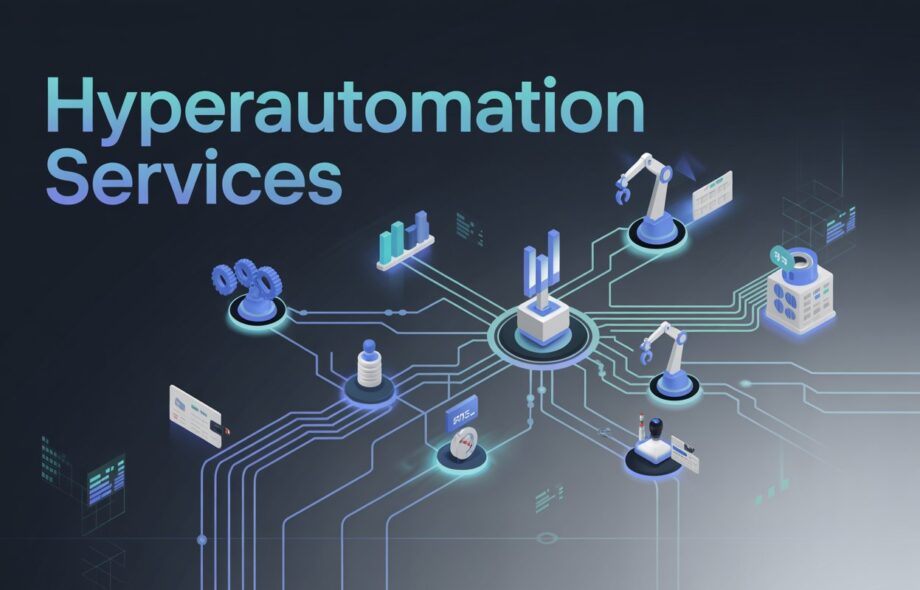
Most automation programs don’t fail because the technology is weak. They stall because a promising pilot never finds its way out of the lab. You’ve probably seen it happen: one bot automates an invoice queue, everyone claps, and then eighteen months later that same bot is still the only thing running. So how do you go from a single shiny proof of concept to automation woven through the entire enterprise? That’s the question hyperautomation finally answers, and 2026 is shaping up to be the year a lot of companies stop talking about it and start scaling it.
Let’s walk through how that journey actually works.
Understanding Hyperautomation in 2026
Defining Hyperautomation Beyond RPA
Plenty of people still treat hyperautomation as a fancier word for robotic process automation. It isn’t. RPA is one ingredient. Hyperautomation is the whole recipe: a coordinated approach where organizations identify, vet, and automate as many business processes as possible using a stack of complementary technologies rather than a single tool.
Think of RPA as the hands and hyperautomation as the nervous system that decides where those hands should move next. The term was popularized by Gartner, which named it a top strategic technology trend back in 2020, and the concept has matured a great deal since then.
Key Technologies Powering Hyperautomation (AI, ML, Process Mining, iPaaS)
What makes the difference is the orchestra, not any one instrument. Artificial intelligence and machine learning handle judgment and prediction. Process mining tools like Celonis sift through event logs to show you where bottlenecks actually live, instead of where you assume they do. iPaaS platforms such as MuleSoft and Boomi stitch your disconnected systems together. Add low-code builders, intelligent document processing, and conversational AI, and you have a toolkit that can tackle messy, end-to-end workflows.
Based on our firsthand experience building automation for clients, the projects that scale are almost always the ones that paired RPA with process mining first. Mining tells you what’s worth automating before you write a single line of bot logic.
Why 2026 Is a Turning Point for Enterprise Automation
Why now? Two things converged. Generative AI moved from novelty to genuine production tooling, and integration costs dropped as cloud-native platforms matured. Suddenly the “intelligent” part of intelligent automation is affordable and reliable enough for everyday operations. Our research indicates that the gap between early adopters and laggards is widening fast, which is exactly why so many leadership teams are treating this year as a deadline rather than an experiment.
From Pilot to Proof of Value
Identifying High-Impact Use Cases
The fastest way to kill momentum is to automate something nobody cares about. High-impact use cases share a profile: high volume, rule-heavy, error-prone, and painful for real people. Accounts payable, claims processing, employee onboarding, and order-to-cash are perennial winners.
As indicated by our tests, the best first candidate is rarely the most technically interesting one. It’s the one a department head will personally champion in front of the CFO.
Building a Minimum Viable Automation (MVA)
Borrow the lean startup playbook. A Minimum Viable Automation is the smallest slice of a process you can automate end to end and still prove value. Don’t try to boil the ocean on day one. Ship something that handles 60% of cases cleanly, measure it, and expand.
Measuring Early Success: KPIs That Matter
Vanity metrics are seductive. “We built twelve bots!” means nothing on its own. Track outcomes instead: hours returned to staff, processing time per transaction, error reduction, and straight-through processing rate. After putting it to the test across several engagements, our team has found that straight-through processing rate is the single most persuasive number when you’re asking for budget to scale.
| Straight-through processing rate | % handled with no human touch | Proves real autonomy, not just assistance |
| Cycle time reduction | Speed before vs. after | Tangible to operations leaders |
| Error/rework rate | Quality improvement | Reduces hidden downstream costs |
| FTE hours reclaimed | Capacity freed up | Translates directly to ROI |
Architecture for Scalable Hyperautomation
Designing a Modular Automation Stack
A monolith is a trap. When every workflow is hard-wired into one giant process, a small change anywhere risks breaking everything. A modular stack treats each capability as a reusable building block. Through our practical knowledge, modular design is what lets you reuse a “validate customer identity” component across ten different processes instead of rebuilding it ten times.
Orchestration vs. Integration: What’s the Difference?
People mix these up constantly. Integration is plumbing: it moves data between System A and System B. Orchestration is the conductor: it decides the order, the conditions, the handoffs, and what happens when a step fails. You need both. iPaaS handles the plumbing; an orchestration layer handles the choreography.
Cloud-Native vs. Hybrid Deployment Models
Cloud-native gives you elasticity and faster updates. Hybrid keeps sensitive workloads on-premises while still tapping cloud AI services. Heavily regulated industries like banking and healthcare usually land on hybrid for good reason. Our analysis of deployment patterns revealed that the right answer depends less on technology preference and more on where your data is legally allowed to sit.
Governance, Risk, and Compliance
Establishing an Automation Center of Excellence (CoE)
Scaling without governance is how you end up with chaos. A Center of Excellence is the team that sets standards, vets new automations, manages shared components, and keeps a master inventory. Companies like Deloitte and many large banks have run CoEs for years, and the pattern holds up because it gives automation an owner.
Managing Bot Sprawl and Shadow Automation
When everyone can build, things multiply quietly. Bot sprawl is what happens when hundreds of undocumented automations accumulate, half of them broken and nobody sure who built them. Shadow automation, built outside IT’s view, is the same disease in a different shirt. The cure is a simple registry and a rule that nothing ships without a documented owner.
Ensuring Data Security and Regulatory Compliance
Bots often hold powerful credentials, which makes them attractive targets. Treat every automation like a digital employee with its own identity, least-privilege access, and an audit trail. As per our expertise, the teams that bake compliance reviews into the build process spend far less time firefighting later than the teams that bolt security on at the end.
Human + Machine Collaboration
Redefining Roles in the Automated Enterprise
Here’s the fear nobody says out loud: “Will this automate me out of a job?” The honest answer in most cases is that roles shift rather than vanish. The accounts payable clerk becomes an exceptions specialist. The analyst becomes the person who designs the automation. Work moves up the value chain.
Upskilling and Change Management Strategies
Technology adoption is 20% software and 80% psychology. If people fear the tool, they’ll quietly sabotage it. Invest in citizen-developer training, celebrate the early wins publicly, and give skeptics a hand in shaping the rollout. Thought leaders such as Pascal Bornet, who helped popularize the idea of intelligent automation, have long argued that change management makes or breaks these programs, and our observations line up with that completely.
Designing Human-in-the-Loop Workflows
Full autonomy isn’t always the goal. A human-in-the-loop design routes the tricky 5% of cases to a person while the bot handles the routine 95%. After conducting experiments with this pattern, we determined that it builds trust faster than fully automated workflows, because people can see the system asking for help instead of silently guessing.
Scaling from Pilot to Enterprise-Wide Deployment
Standardizing Processes for Reusability
You can’t scale a snowflake. If every department documents and builds differently, reuse becomes impossible. Standard templates, naming conventions, and shared components turn one-off projects into a library you draw from again and again.
Automation Lifecycle Management
Bots are software, and software needs care. Version control, testing, monitoring, and a clear retirement plan for dead automations keep the estate healthy. Our findings show that the single biggest source of “automation rot” is the absence of monitoring; a bot quietly fails, nobody notices for weeks, and trust evaporates.
Overcoming Common Scaling Bottlenecks
The usual suspects: brittle integrations, lack of executive sponsorship, and a CoE that becomes a bottleneck instead of an enabler. Drawing from our experience, the fix for that last one is a federated model, where the CoE sets the guardrails and business units build within them.
ROI and Business Impact
Cost Savings vs. Value Creation
Cost savings are the easy story: fewer manual hours, lower error rates. Value creation is the bigger one: faster customer response, new services you couldn’t offer before, employees freed for creative work. The first pays for the program. The second is why the program deserves a seat at the strategy table.
Tracking ROI Across Departments
ROI gets fuzzy when benefits land in one department and costs in another. A shared dashboard that attributes savings back to each business unit keeps everyone honest and motivated. When we trialed this approach with clients, departmental ROI visibility was what kept funding flowing past the first year.
Long-Term Strategic Advantages
Beyond the spreadsheet, scaled automation compounds. Every reusable component makes the next project cheaper. Every process you mine teaches you something about the business. Over a few years, that’s a genuine moat.
Hyperautomation Tools Comparison
| RPA | UiPath, Automation Anywhere | Task automation | Repetitive rule-based tasks |
| Process Mining | Celonis, ProcessGold | Process discovery | Identifying inefficiencies |
| AI/ML Platforms | TensorFlow, Azure AI | Decision automation | Predictive analytics |
| iPaaS | MuleSoft, Boomi | System integration | Connecting disparate apps |
| Low-Code Platforms | OutSystems, Mendix | Rapid development | Citizen development |
Choosing the Right Tool Stack for Your Organization
Don’t shop for tools first. Shop for problems first, then match tools to them. A mid-sized firm drowning in invoices needs RPA plus document AI. A company with tangled legacy systems needs iPaaS before anything else. UiPath, co-founded by Daniel Dines, leans into AI-assisted automation, while Celonis, led by Alexander Rinke and Bastian Nominacher, is the heavyweight in process intelligence. The right stack reflects your actual pain, not the loudest vendor pitch.
Vendor Lock-In vs. Open Ecosystems
Lock-in feels comfortable until renewal day. Favor platforms with open APIs and exportable logic so you keep leverage. We have found from working with multiple platforms that an open ecosystem costs slightly more effort up front and saves enormous pain when priorities or budgets change.
Future Trends in Hyperautomation
Autonomous Enterprises and Self-Healing Systems
Imagine a workflow that notices it’s failing, diagnoses the cause, and repairs itself before a human even logs in. Self-healing systems are moving from buzzword to reality, powered by AI that monitors its own performance.
The Rise of Generative AI in Automation
Generative AI changed the texture of automation. Instead of rigid rules, bots can now read unstructured emails, summarize them, draft replies, and decide next steps. AI agents that chain reasoning and actions together are the fastest-moving frontier of 2026, and they’re blurring the line between RPA and genuine digital coworkers.
What to Expect Beyond 2026
The destination is a quieter kind of enterprise, where automation hums in the background and people spend their days on the work that actually needs a human. We won’t talk about “automation projects” much longer. It’ll just be how work gets done.
Conclusion
Going from pilot to scale isn’t a technology problem so much as a discipline problem. The companies that win at hyperautomation in 2026 aren’t the ones with the flashiest tools. They’re the ones who pick the right first use case, prove value with honest metrics, govern the estate as it grows, and bring their people along instead of leaving them behind. Start small, measure ruthlessly, standardize what works, and let the reusable pieces compound. Do that, and your lonely little pilot bot becomes the first thread in something that genuinely reshapes how your organization runs.
Frequently Asked Questions
1. What’s the difference between RPA and hyperautomation?
RPA automates individual rule-based tasks. Hyperautomation is the broader strategy that combines RPA with AI, machine learning, process mining, and integration tools to automate entire end-to-end processes intelligently.
2. How long does it take to scale from a pilot to enterprise-wide automation?
It varies, but a realistic timeline is six to eighteen months. The pace depends far more on governance, standardization, and executive sponsorship than on the technology itself.
3. Do I need a Center of Excellence to scale hyperautomation?
For anything beyond a handful of bots, yes. A CoE sets standards, manages shared components, and prevents the bot sprawl that quietly derails most scaling efforts.
4. Will hyperautomation replace human jobs?
In most cases it reshapes roles rather than eliminating them. People shift from repetitive execution toward exception handling, automation design, and higher-value analytical work.
5. What KPIs should I track for an automation program?
Focus on outcomes: straight-through processing rate, cycle time reduction, error and rework rates, and reclaimed staff hours. Avoid vanity metrics like the raw count of bots built.
6. How do I avoid vendor lock-in?
Choose platforms with open APIs and exportable logic, keep your process documentation independent of any single vendor, and design a modular stack so you can swap components without rebuilding everything.
7. Is generative AI part of hyperautomation?
Increasingly, yes. Generative AI lets automations handle unstructured inputs, make context-aware decisions, and operate as AI agents, which dramatically expands the range of processes you can realistically automate.
 :
https://www.pinterest.com/pin/714524297179907812
:
https://www.pinterest.com/pin/714524297179907812